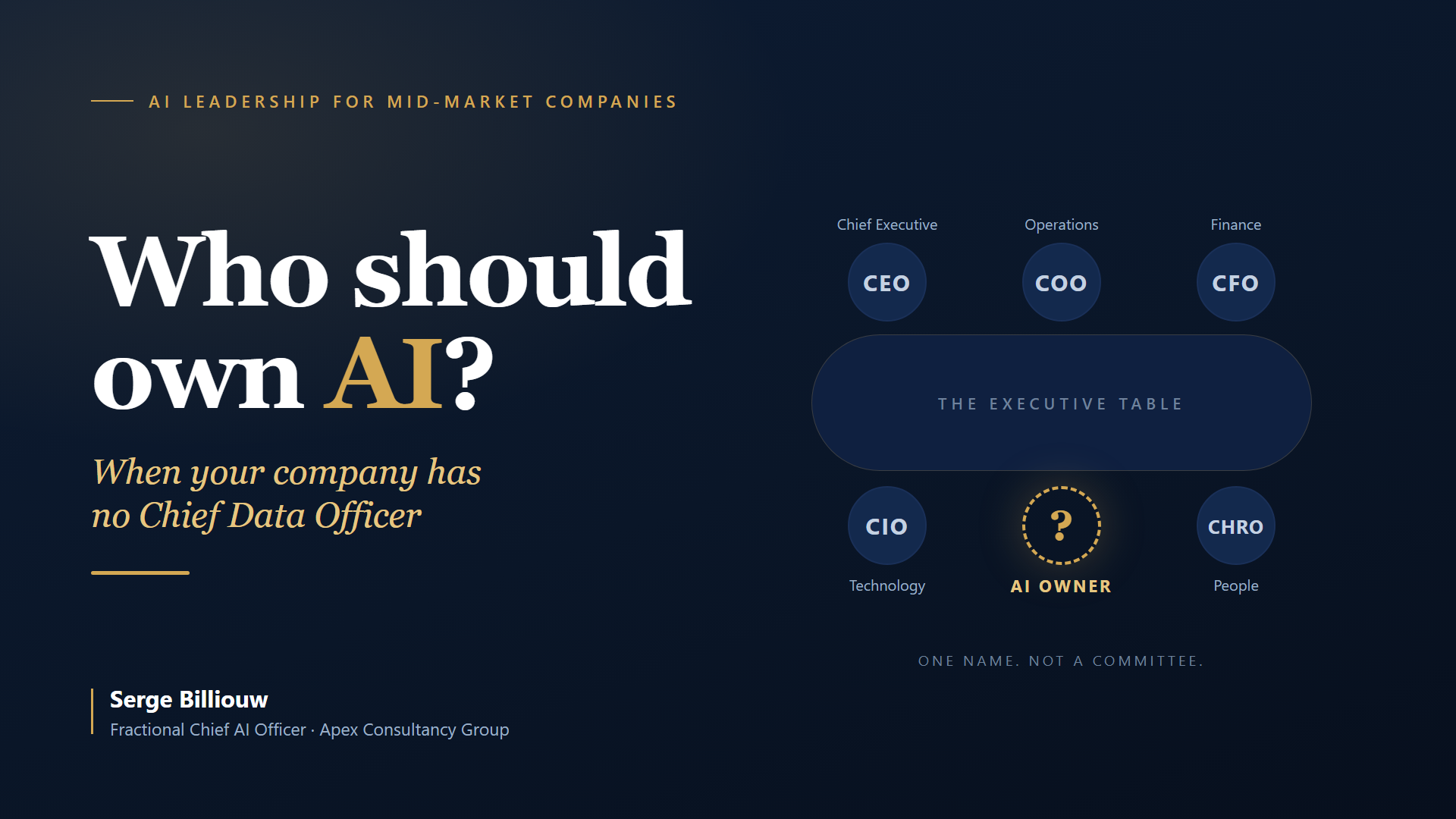
One named executive who already sits on the leadership team should own AI. In most mid-market companies that is the COO; in some it is the CFO or the CEO. It should not be the IT department, and it should not be a committee. If nobody on the team has the time or the experience, a fractional Chief AI Officer can hold the role part-time until the company is ready for a full-time leader.
The rest of this article explains why, and how to choose.
“Sort of owned” means not owned
Ask a leadership team who owns AI and you usually hear three answers. Sort of IT. Sort of the data people. Sort of everyone.
Each of those means nobody is accountable. Tools get bought, pilots get started, and nothing reaches the point where it changes a number the board cares about.
A quick test: ask five of your leaders, separately, who owns AI in the company. If you get more than one name, you do not have an owner.
What the owner is responsible for
The owner is accountable for the result. That is a business job, and it has five parts.
- People. Someone sponsors AI at the executive table, and employees are prepared to use what gets built.
- Rules. Employees know which AI tools they may use and with which data, and someone reviews the risky uses.
- Foundation. The data needed for the priority problems is known, owned and usable.
- Priorities. The company has chosen where AI should create value, in what order, with a budget.
- Proof. Every initiative starts with a baseline and a measurable outcome, and the results are reported.
These are the five layers of Exec AI OS: ALIGN, ASSURE, ARCHITECT, ADVANCE and ATTEST. The owner does not do all of this personally. The owner makes sure each part has a name next to it.
The candidates
| Candidate | When it works | The risk |
|---|---|---|
| COO | AI’s value is in operations: service, delivery, cost, quality. This is the most common case. | Too little time, unless something else comes off the plate. |
| CFO | The company is cautious and wants every initiative tied to a business case. | AI becomes a cost exercise and nothing new gets tried. |
| CEO | A smaller company, or the first six months, to show it matters. | It does not last. The CEO’s attention moves on. |
| Head of IT or CIO | IT already works closely with the business and has its trust. | AI becomes a technology project: tools get installed and nobody changes how they work. |
| A committee | Never as the owner. Useful as an advisory group to the owner. | Everyone attends, nobody decides. |
| Fractional Chief AI Officer | Nobody on the team has both the time and the experience. | It only works with a real seat at the executive table and a sponsor inside. |
Why not IT?
IT owns the systems. The value of AI shows up somewhere else: in how a claim gets processed, how a customer gets answered, how a forecast gets made. The person who owns that work has to want the change. If IT owns AI alone, you get working tools and unchanged habits.
IT is essential to the third layer, the foundation. It is rarely the right owner of the whole.
What the owner needs
- A seat at the executive table, reporting to the CEO.
- A budget they control.
- Time. This cannot be done in the margins of a full job.
- Enough understanding of AI to ask good questions and to tell a real result from a good demo. They do not need to be technical.
If your best candidate has the first two and lacks the last two, that is the gap to fill.
When a fractional Chief AI Officer makes sense
A fractional Chief AI Officer is a senior executive who leads the company’s AI agenda part-time. It fits when the company needs AI leadership now, cannot yet justify a full-time hire, and has no executive with both the time and the background.
It works best alongside an internal sponsor, usually the COO or CEO, who holds the authority while the fractional executive brings the method and the experience. Part of the job is to prepare the company for the day it hires its own full-time AI leader.
I describe how I work in that role on the fractional CAIO page.
Where to start this week
- Ask the five-leaders question above.
- Name one owner, in writing, with a budget.
- Find out which of the five layers is weakest. The free self-assessment takes about five minutes.
Common questions
Should the CEO own AI? At the start, yes, to show it matters. After that the CEO should sponsor it and delegate ownership to one executive.
Can IT own AI? IT should own the technical foundation. The business outcome needs an owner in the business.
Do we need a Chief AI Officer? Most mid-market companies do not need a full-time one yet. They need one accountable executive, and sometimes part-time help from a fractional Chief AI Officer.
Can an AI committee own it? No. A committee can advise the owner. It cannot be accountable.
Serge Billiouw is a fractional Chief AI Officer (CAIO) for mid-market companies and the founder of Apex Consultancy Group. He is the creator of Exec AI OS.
Executive AI & GenAI Accelerator Workshop
In one private session, I align your entire leadership team on a common language and an ROI-driven roadmap, turning ambiguity into a clear, actionable plan. Learn more about the workshop.